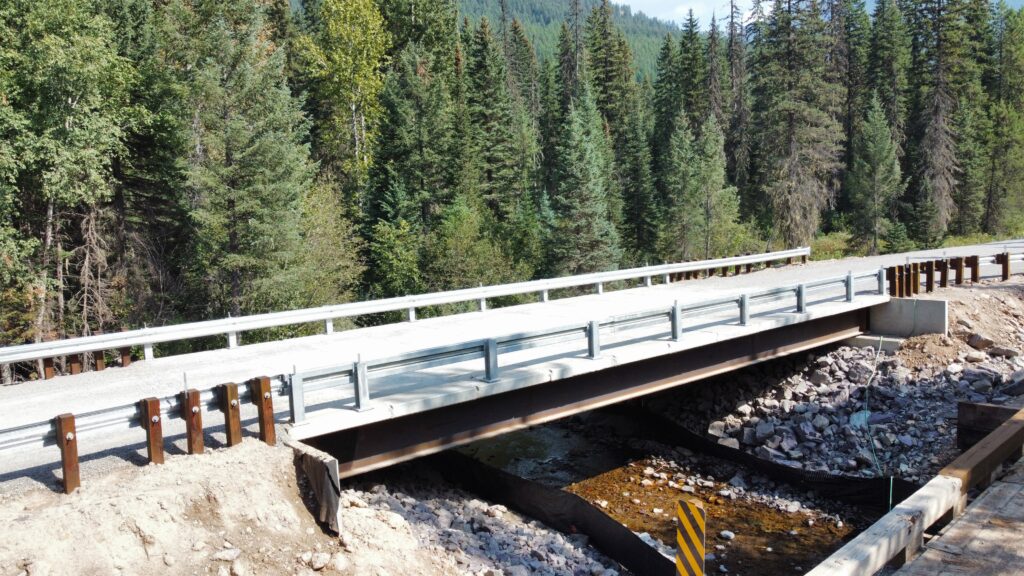
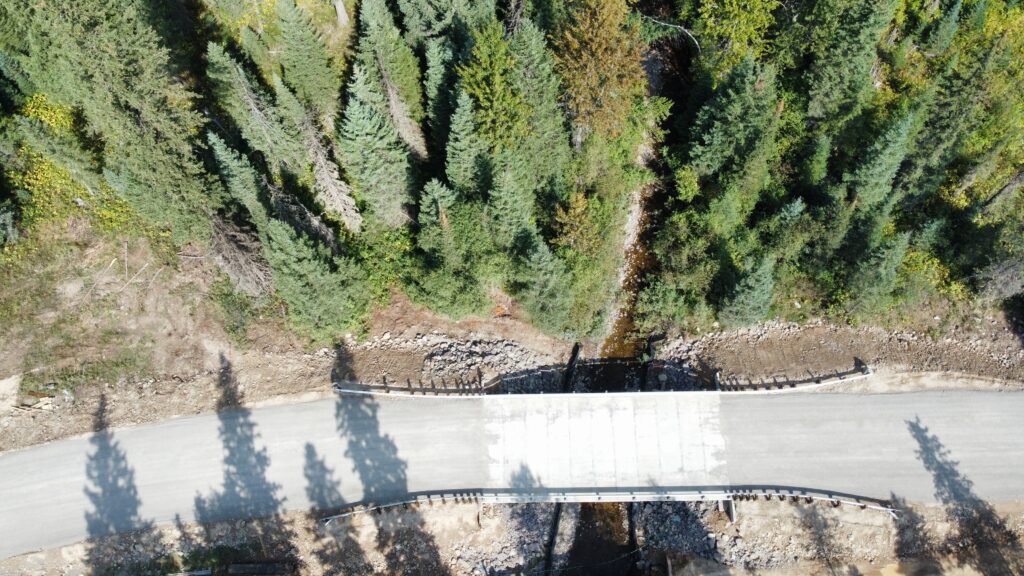
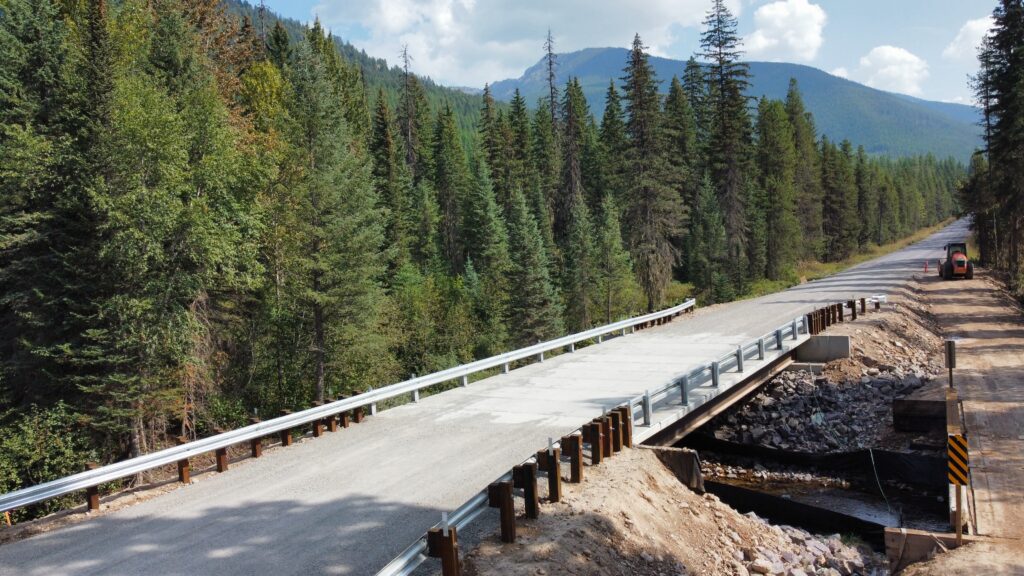
In 2025, Glacier Precast Concrete — based in Kalispell, Montana — was awarded the contract to fabricate replacement bridge components and abutments for the Tiger Creek Bridge, a U.S. Forest Service project located in the South Fork of the Flathead River drainage in northwestern Montana. From our NPCA-certified precast concrete plant in the Flathead Valley, we delivered precision-engineered components built with purpose-designed steel formwork, hot-dip galvanized embeds, and a concrete mix designed to exceed a 100-year service life in one of the most remote and unforgiving environments in the Lower 48.
This is the story of how we delivered it — on time, on spec, and to the highest praise the USFS project lead gave all year.
The Setting: South Fork Flathead River Drainage
The South Fork of the Flathead River originates deep in the Bob Marshall Wilderness and flows roughly 98 miles north-northwest through some of the most pristine forested landscape in the western United States. The watershed sits within the Flathead National Forest, adjacent to Glacier National Park and the Great Bear Wilderness, and is home to federally threatened bull trout and the largest connected population of genetically unaltered migratory westslope cutthroat trout remaining in the country.
Infrastructure in this drainage must be built to a higher standard. Harsh winters, spring runoff, freeze-thaw cycling, and the environmental sensitivity of the corridor all impose strict constraints on materials, construction timelines, and design life. When the USFS specified a 100+ year service life for the Tiger Creek Bridge replacement, they weren’t being aspirational — they were being practical. Replacing a bridge in a drainage this remote is enormously expensive and logistically difficult. You build it once, and you build it right.
Precast Bridge Engineering and Design Scope
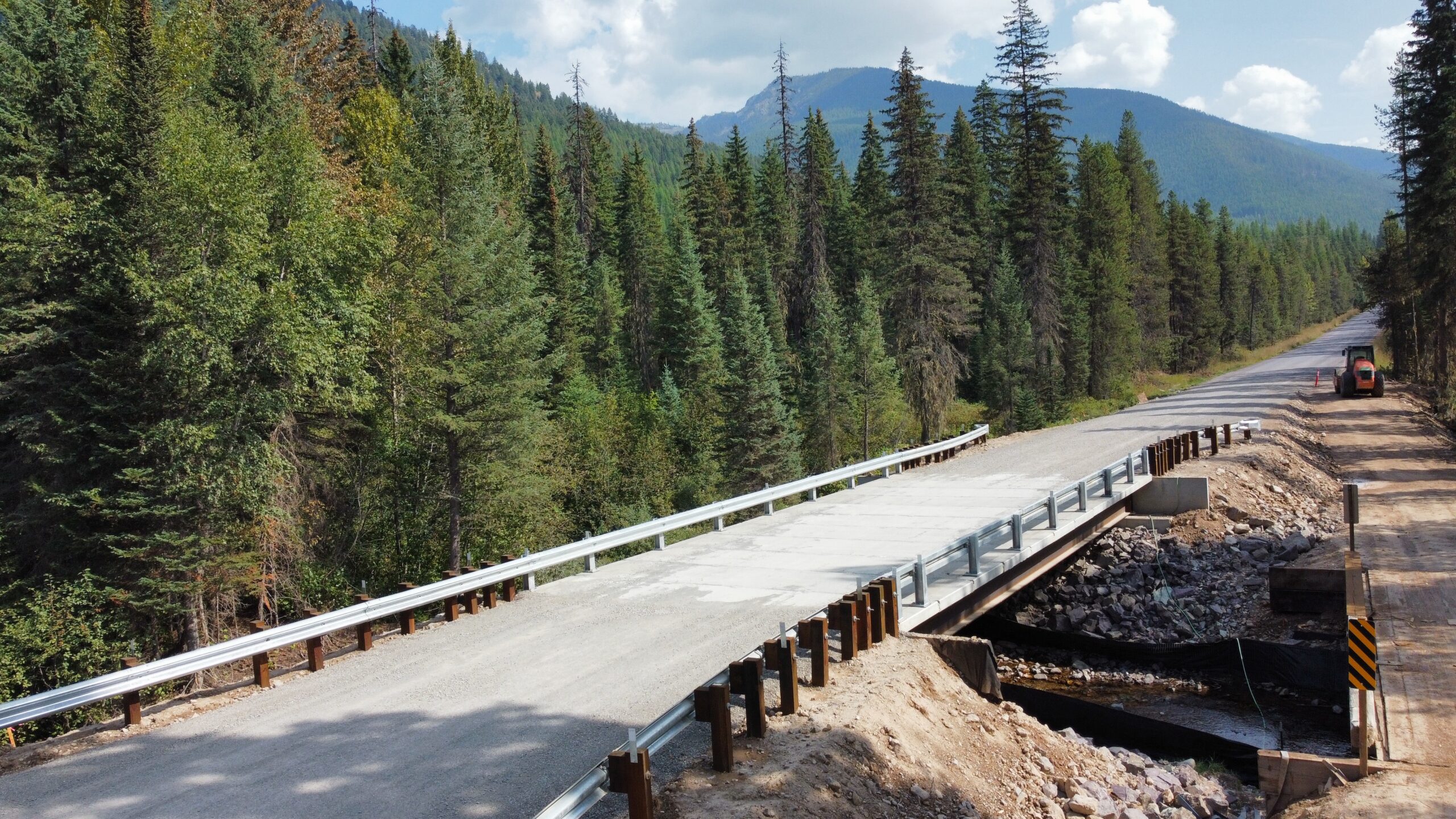
The Tiger Creek Bridge is approximately 60 feet in span length, sized for a two-lane road, and serves as a critical access point within the USFS road network in the South Fork drainage. The scope of work awarded to Glacier Precast Concrete included the fabrication of precast concrete bridge components and bridge abutments, along with all associated steel embeds.
After contract award, our engineering team worked directly with the project’s engineering firm to develop a complete submittal package. This is a critical phase in any precast bridge project — the submittals define concrete mix designs, reinforcement detailing, embed placement tolerances, form dimensions, and galvanizing specifications. Every detail must align with both the structural design intent and the AASHTO LRFD Bridge Design Specifications that govern load rating, durability, and long-term performance. The submittals were reviewed, revised where necessary, and approved before we moved into production.
Custom Precast Fabrication: Steel Forms and Galvanized Embeds
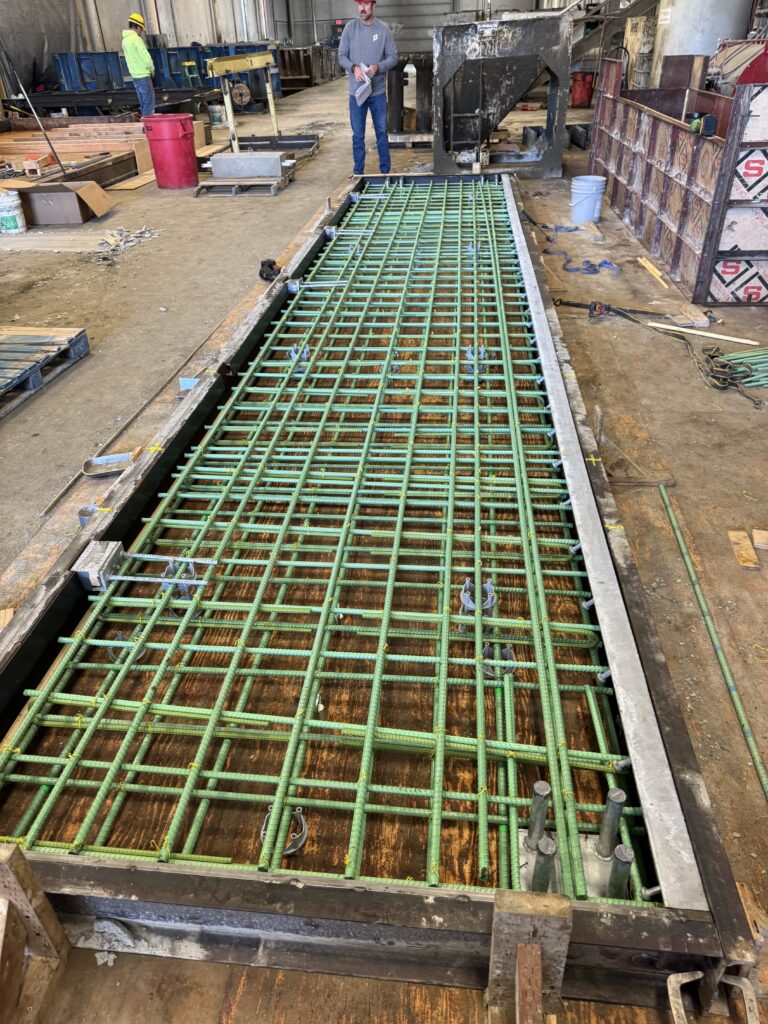
Once submittals were locked in, we transitioned to fabrication at our Kalispell, Montana precast concrete plant. For a project of this complexity, off-the-shelf forms won’t cut it. Our team designed and built custom steel forms specifically for the Tiger Creek bridge components. Custom formwork is essential when you’re producing precast elements that need to hit tight dimensional tolerances — the abutments and bridge parts must mate precisely with both the subgrade foundation system and the superstructure during field installation.
The steel embeds — anchor plates, bearing assemblies, connection hardware, and other cast-in components — were fabricated and then sent to Spokane, Washington, the nearest hot-dip galvanizing facility to our Kalispell plant. Hot-dip galvanizing was a non-negotiable specification on this project, and for good reason.
Why Hot-Dip Galvanizing Matters for a 100-Year Bridge
Hot-dip galvanizing (HDG) is the process of immersing fabricated steel into a bath of molten zinc at approximately 840°F, creating a metallurgically bonded zinc-iron alloy coating on the steel surface. This coating provides three layers of corrosion defense: barrier protection (isolating the steel from the environment), cathodic protection (zinc sacrificially corrodes before the underlying steel), and the zinc patina (corrosion byproducts form an additional passive barrier that slows the corrosion rate to approximately 1/30th that of bare steel in the same environment).
For bridge infrastructure in western Montana, HDG is one of the most proven paths to achieving a 100-year design life with minimal maintenance. The American Galvanizers Association has documented galvanized bridge structures still performing well after 50+ years of service with original coating thicknesses largely intact. In remote locations like the South Fork Flathead drainage — where routine maintenance access is limited and winters are severe — galvanizing eliminates the lifecycle cost burden of recoating or repainting that painted steel bridges require every 15–25 years.
The Spokane round-trip for galvanizing added lead time and logistics to the project, but it was non-negotiable for the durability requirements. When you’re engineering for a century of service, you don’t cut corners on corrosion protection.
Precast Concrete Production and Delivery Timeline
Fabrication began in March 2025, with form construction and embed production running in parallel at our Kalispell facility. Concrete pours for the bridge components and abutments followed through April and into early summer. Precast concrete production in a controlled plant environment — as opposed to cast-in-place work in the field — provides significant quality advantages: consistent concrete consolidation, controlled curing conditions, tighter dimensional tolerances, and the ability to inspect and test components before they ever leave the yard.
Our automated batch plant can pour over 120 cubic yards of concrete per day, giving us the capacity to handle large-scale bridge component production without compromising quality or timelines.
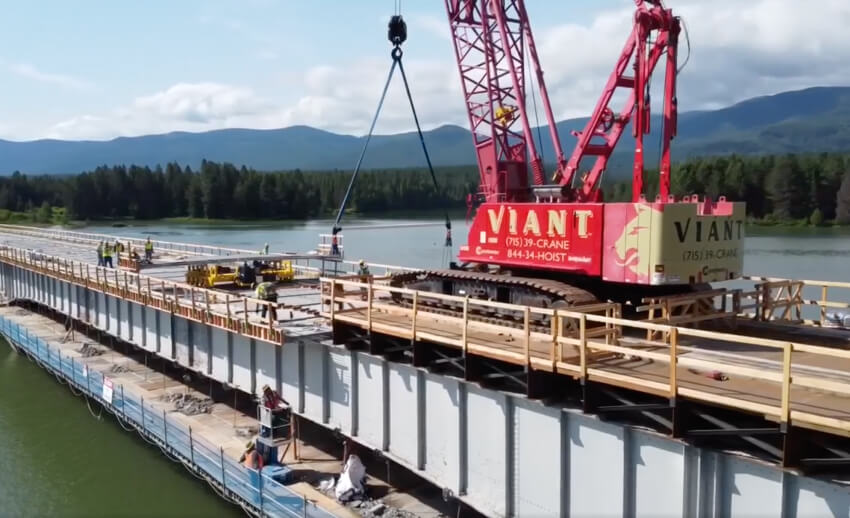
Glacier Precast delivered the completed precast bridge components and abutments to the USFS project site in August 2025. Field installation was completed within a few weeks — a testament to the precision of the precast approach. When components are fabricated to spec in a certified plant, field assembly becomes a logistics exercise rather than a construction gamble.
Project Results: On-Time, On-Spec Precast Bridge Delivery
The Tiger Creek Bridge project was completed on schedule, meeting all engineering specifications and the USFS’s 100+ year design life requirement. The USFS Project Lead stated it was the best-run project they had all year.
For Glacier Precast Concrete, this project represents exactly the kind of technically demanding, high-stakes infrastructure work we’re built for. We’ve been producing precast concrete in Montana’s Flathead Valley since 1989, and we hold both NPCA (National Precast Concrete Association) certification — meaning our plant, processes, and products meet the most stringent industry quality standards.
Frequently Asked Questions
What is the advantage of precast concrete over cast-in-place for bridge construction?
Precast concrete bridge components are manufactured in a controlled plant environment, which provides several advantages over cast-in-place construction. Plant production delivers more consistent concrete consolidation, controlled curing conditions, and tighter dimensional tolerances. Components can be inspected and tested before leaving the yard, reducing field risk. For remote sites like those in Montana’s backcountry, precast also dramatically reduces on-site construction time — the Tiger Creek Bridge components were installed in just a few weeks after delivery, compared to the months of formwork, pouring, and curing that cast-in-place would have required.
How does an NPCA certification benefit a precast concrete project?
NPCA (National Precast Concrete Association) certification means a precast plant undergoes rigorous third-party audits of its production processes, quality control procedures, raw materials, and finished products. For project owners and general contractors, specifying NPCA-certified precast reduces risk — you’re working with a facility that meets nationally recognized quality standards for mix design, reinforcement placement, curing, and dimensional accuracy. Glacier Precast Concrete has maintained NPCA certification at our Kalispell, Montana plant for projects serving both domestic and Canadian markets.
What types of precast bridge components can be fabricated in Montana?
Glacier Precast Concrete fabricates a full range of precast bridge components from our Kalispell, Montana facility, including bridge deck panels, prestressed girders, bridge abutments, wing walls, box culverts, and custom structural elements. Our in-house engineering team handles everything from structural design and shop drawings to custom formwork fabrication, and our automated batch plant supports large-volume pours for projects of any scale. We serve general contractors, public agencies, and engineering firms throughout Montana, Idaho, and western Canada.
Need Precast Bridge Components or Custom Concrete Solutions?
If you’re a general contractor, public agency, or engineering firm working on bridge replacements, abutments, box culverts, or other precast infrastructure in Montana or the surrounding region, Glacier Precast Concrete can help. We specialize in custom precast solutions for technically demanding projects — from initial engineering through fabrication and delivery.
Glacier Precast Concrete 175 Alder Dr, Kalispell, MT 59901 Phone: (406) 752-7163 Web: glacierprecast.com Hours: Monday–Friday, 7:00 AM – 5:00 PM
NPCA Certified | Serving Montana, Idaho, and Western Canada Since 1989