A technical guide from the team at Glacier Precast Concrete
Erik Powell | April 2026 (Updated)
You Invested in a System — Here’s How to Protect It
A new septic system represents a significant capital investment — typically $5,000 to $15,000 installed in Flathead County. Like any engineered system, it will perform reliably for decades with proper maintenance, or fail prematurely without it. A failed drain field can cost $30,000 or more to remediate, including interior damage to flooring, drywall, and framing if a backup reaches your home.
This guide explains not just what to do, but why — so you understand the system you’re operating and can recognize early warning signs before they become expensive problems.
Understanding What You’re Actually Managing
A modern septic system is a two-stage biological treatment train, not simply a holding tank. Understanding both stages is essential to understanding maintenance.
Stage 1: The Septic Tank
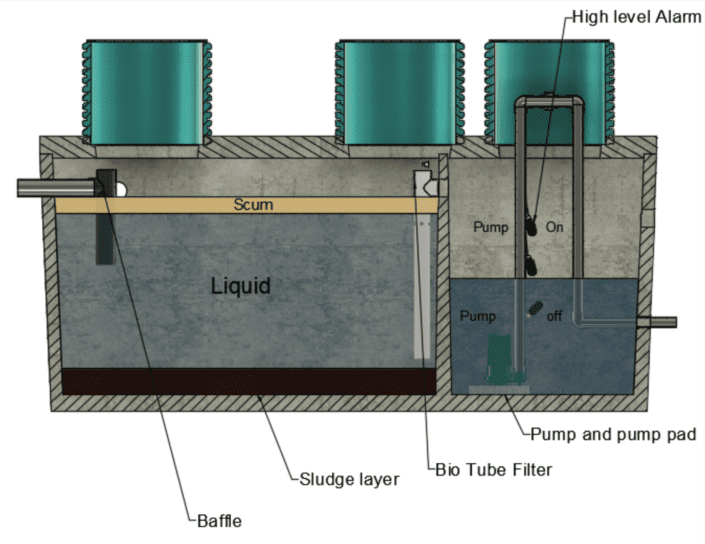
Wastewater from your home enters the septic tank, where anaerobic bacteria (bacteria that function without oxygen) digest organic material. The tank naturally separates into three layers:
- Sludge (bottom): Settled solids that are slowly digested by bacteria
- Clarified effluent (middle): The treated liquid layer that exits to the drain field
- Scum (top): Fats, oils, and grease that float and accumulate over time
A properly sized tank provides 24 to 72 hours of hydraulic retention time — enough time for biological treatment and gravity separation to occur before effluent moves downstream.
Stage 2: The Pressurized Dosing System and Drain Field
Most modern systems in our area use a pressurized dosing configuration rather than a simple gravity-fed drain field. This is a meaningfully more engineered system with important implications for how you maintain it.
Clarified effluent flows from the septic tank into a separate pump chamber. A float-controlled pump fires in timed doses, delivering effluent through a pressurized distribution network to the drain field. Each dose is calibrated to push approximately five times the volume needed to fill the lateral lines — this clears the lines completely between cycles rather than allowing effluent to sit and stagnate in the pipes.
The effluent filter protecting the pump chamber inlet has a 1/8-inch (0.125”) aperture. The distribution orifices in the drain field laterals are 5/32-inch (0.156”). This geometry is intentional: nothing that passes the filter can mechanically plug a distribution orifice. The filter is the sacrificial, cleanable component. The drain field is the irreplaceable one.
In the drain field, aerobic bacteria in the soil matrix provide a final treatment stage as effluent percolates downward through the aggregate bed and native soil. This is where the final biological treatment and filtration occur before water rejoins the groundwater table.
The Biology You’re Protecting
The microbial community in your septic tank is the engine of the entire system. It includes billions of bacteria and archaea (from our gut biome) per milliliter of tank liquid — a complex consortium that took weeks to establish after your system was first loaded. This community is doing real biological work: breaking down organic solids, reducing biochemical oxygen demand, and preventing raw sewage from reaching your drain field.
The practical implication: anything that kills this microbial community degrades your entire system. The damage doesn’t show up immediately, but over weeks to months, digestion efficiency drops, solids accumulate faster, and effluent quality deteriorates.
What to Keep Out of Your System
Fats, Oils, and Grease (FOG): This is the single most important thing to keep out of your drains. FOG passes through the effluent filter in liquid phase and accumulates at the soil interface in the drain field, forming a low-permeability biomat. Unlike a gravity system where this buildup is gradual, a pressurized dosing system delivers FOG in concentrated pulse events — high-velocity doses that can drive FOG deeper into the soil pore structure. A failed drain field from FOG occlusion costs $5,000 to $30,000 to replace and cannot be reversed biologically. Never pour cooking grease, bacon fat, or fry oil down any drain.
Solvents and Automotive Fluids: Paint thinner, acetone, gasoline, oil, antifreeze, and transmission fluid are acutely toxic to your tank’s microbial community at very low concentrations. Gasoline also contains BTEX compounds (benzene, toluene, ethylbenzene, xylene) that pass through soil with minimal attenuation and can contaminate groundwater. Montana’s MDEQ groundwater standard for benzene is 5 micrograms per liter — a single incident can exceed this. None of these substances belong anywhere near a drain.
Pesticides and Herbicides: These compounds are engineered to disrupt biological systems. Even rinsing a pesticide container in a sink can introduce sufficient concentration to suppress your tank’s anaerobic digestion community for weeks. Rinse containers outside, not at a sink drain.
Non-Biodegradable Solids: Wipes (including those labeled “flushable” — they don’t degrade on any relevant timescale), diapers, feminine hygiene products, and similar items accumulate in the tank and can jam the pump impeller. This is a mechanical problem, not a biological one, but the result is the same: system failure.
Disinfectants and Antibacterials: Occasional use of bleach-based cleaners at normal household concentrations will not sterilize your tank — the microbial population is large enough to recover. Chronic heavy use (daily bleach flushing, constant antibacterial soap use) does measurably suppress the active community over time. A reasonable guideline: no more than one cup of bleach per week entering the system, across all sources.
Clean Water Sources: Footing drains, sump pump discharge, and roof drains must never be connected to a septic system. During Flathead County snowmelt events, a sump pump can discharge hundreds of gallons per hour — this hydraulically dilutes the pump chamber, increases pump cycle frequency (accelerating motor wear), and can overload the drain field’s hydraulic capacity. Montana code prohibits this connection. Check your installation if you’re unsure.
Septic Additives (Biological and Chemical): Commercial septic additives are not supported by credible scientific evidence. The EPA and NSF have reviewed these products extensively: there is no demonstrated benefit in a properly functioning system. Your tank already contains an established, highly adapted microbial community. Adding freeze-dried bacteria from a packet is the equivalent of adding a cup of water to a lake. Save your money.
Water softeners: the discharge from your water softener should not enter your septic system. The salt acts to inhibit the breakdown of your waste. The softener discharge should be run outside or into a drywell away from the septic system
Your Maintenance Schedule
The following table summarizes every maintenance action, frequency, and what failure mode it prevents. This is your complete checklist.
| Task | Frequency | What It Prevents |
| Test alarm button (TEST switch on panel) | 2x per year | Electrical/pump failure warning |
| Physically raise high-level float — confirm alarm sounds | 1x per year | Float or switch malfunction |
| Remove effluent filter, pressure-wash, reinstall | 1x per year | Pump overload / motor burnout |
| Inspect and clean inlet/outlet baffles | 1x per year | Short-circuit flow, solids carryover |
| Note pump cycle frequency (increase = infiltration; decrease = failure) | Ongoing | Early warning indicator |
| Professional pump-out — tank and pump chamber | Every 3-5 years* | Drain field solids migration |
*Pump-out frequency depends on household size and garbage disposal use. A household using a garbage disposal should pump every 2–3 years. When sludge and scum together exceed 30% of tank volume, solids begin migrating toward the outlet — pump before this threshold is reached.
Montana-Specific Considerations
Soil Temperature and Winter Performance
Anaerobic digestion rate is temperature-dependent — biological activity roughly halves for every 10°C drop in temperature (Arrhenius kinetics). Kalispell soil temperatures at tank depth (below the 42-inch frost line required by Montana code) typically reach 4–6°C in winter. Your system is still functioning biologically, but at reduced efficiency. This is normal and expected. It does mean that high-load events in winter (houseguests, holiday gatherings) carry slightly higher risk of short-circuiting the tank’s treatment capacity.
Snowmelt Season
Spring snowmelt is the highest-risk period for hydraulic intrusion from clean water sources. If you notice your high-level alarm activating during snowmelt without corresponding high household water use, investigate immediately for groundwater infiltration into the tank or pump chamber. Concrete tanks with well-maintained joint sealant have significantly lower infiltration rates than other tank types.
Failure Mode Priority: Gravity vs. Pressurized Dosing
If you’ve read general septic maintenance guides, some of the common advice applies differently to your pressurized dosing system. The table below summarizes where the risk profile differs.
| Failure Mode | Gravity System | Pressurized Dosing |
| FOG / drain field biomat | CRITICAL | CRITICAL |
| Chemical or biological kill of tank bacteria | HIGH | HIGH |
| Clean water intrusion (sump, footing drains) | HIGH | HIGH |
| Filter clog / pump motor burnout | N/A — gravity | HIGH (new risk) |
| Hydraulic surge to drain field | HIGH | LOW — mitigated by dose chamber |
| Solids migration to drain field orifices | HIGH | LOW — filter + geometry |
The key insight: a pressurized dosing system with a properly sized effluent filter and engineered orifice geometry largely eliminates the hydraulic surge and solids migration failures that are the dominant failure modes in gravity systems. It does not protect against FOG-driven biomat, chemical kill of the biological community, or clean water intrusion. Those risks are unchanged.
It also introduces a new maintenance-critical item that gravity systems don’t have: the effluent filter and pump. A clogged filter forces the pump to work against elevated head pressure, outside its designed pump curve, resulting in increased motor amperage and accelerated motor wear. Annual filter cleaning costs nothing. Pump replacement costs $500 to $1,500 plus service call. The math is straightforward.
Your High-Level Alarm: Take It Seriously
Your control panel includes a high-level alarm that activates when effluent in the pump chamber rises above a set threshold. This alarm exists because system backups happen fast — a failed pump in a household generating 300+ gallons per day can back up within hours.
If your alarm sounds:
- Reduce water use immediately — showers, laundry, and dishwasher off
- Check the control panel for a tripped breaker or pump fault indicator
- Call a service provider — do not wait to see if it resolves itself
Test your alarm function twice per year using the TEST button on the control panel, and physically raise the float once per year to confirm the audible alarm triggers. A non-functional alarm is as dangerous as no alarm.
Local Service Providers
If you prefer to have maintenance performed professionally — or if you encounter any issue beyond a routine inspection — the following providers serve the Flathead Valley. This is not an exhaustive list, but we have direct working experience with each of them.
| Provider | Phone |
| A-1 Sanitation | 406-755-3938 |
| Advanced Septic Design and Maintenance | 406-752-1507 |
| Pedersen Pumping | 406-752-4321 |
| Ready Freddy | 406-752-4552 |
| Ray Baier Septic | 406-752-6904 |
| Surefire Septic | 406-756-1806 |
For questions about your tank itself — capacity, design specifications, or concerns about structural integrity — Glacier Precast Concrete is your first call. We manufactured and installed your tank and can provide the original engineering documentation.
| Glacier Precast Concrete NPCA Certified · Kalispell, MT · Founded 1989 (406) 752-7163 · glacierprecast.com |
YOUR SEPTIC SYSTEM: QUICK REFERENCE CARD
Keep this posted near your control panel
| ✔ DO THIS Test alarm button 2x per year Raise float to confirm alarm 1x per year Clean effluent filter 1x per year Inspect inlet/outlet baffles 1x per year Pump out every 3–5 years Monitor pump cycle frequency for changes Use disinfectants in moderation only ✘ NEVER DO THIS Pour grease, fats, or cooking oil down any drain Flush wipes — even “flushable” ones Put solvents, paint, or automotive fluids in any drain Rinse pesticide containers at a sink Connect sump pumps or footing drains to the system Ignore your high-level alarm | ⚠ IF YOUR ALARM SOUNDS Stop all water use immediately Check panel for tripped breaker or fault light Call a service provider — do not wait 📋 QUICK FACTS: YOUR SYSTEM Effluent filter aperture: 1/8″ (clean annually) Distribution orifices: 5/32″ (filter protects these) Dose volume: 5x line fill volume (selfp-clearing) Tank pump-out: every 3–5 years Frost line depth (Kalispell): 42 inches |
| Questions about your tank? We manufactured it. Glacier Precast Concrete · (406) 752-7163 · glacierprecast.com |