Glacier Precast Concrete produced six precast buildings for the Montana Department of Transportation’s rest area at Homestake Pass — poured through a Montana winter in Kalispell, hauled 250 miles south, and set in place on time and under budget.
Homestake Pass tops out at 6,393 feet, where Interstate 90 crosses the Continental Divide east of Butte — the highest point on the entire 3,020-mile highway. It’s high, it’s exposed, and it takes a Montana winter head-on. When the Montana Department of Transportation (MDT) needed new rest area buildings up there, they needed structures built to match the place. Glacier Precast Concrete won that job last winter, and it’s the kind of work we’re built for.
The project: six precast buildings for a Continental Divide rest area
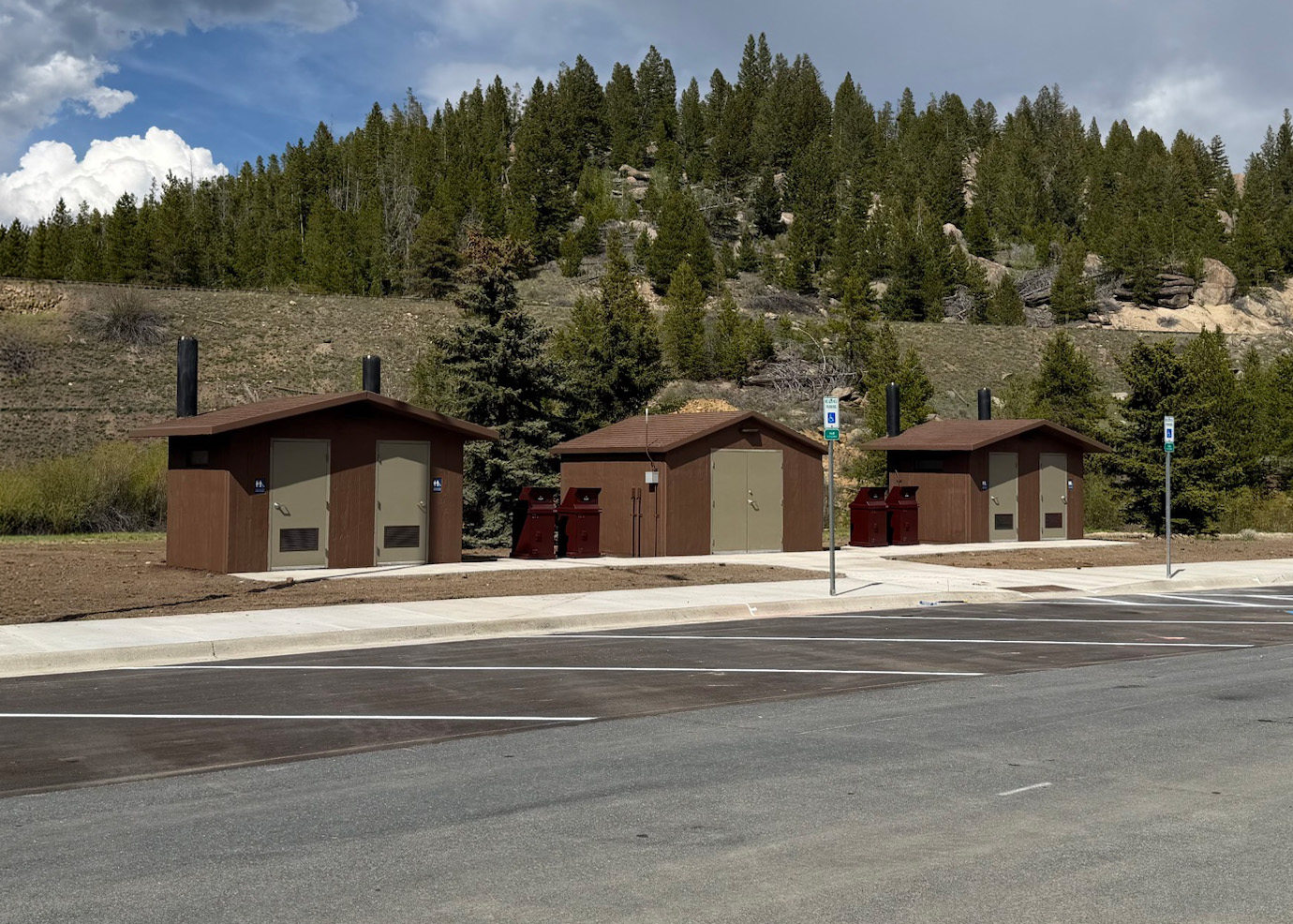
The scope was six precast buildings: four double-latrine restroom buildings and two 8×12 utility buildings. These aren’t disposable structures. They sit at one of the highest points on I-90, serving travelers year-round through the freeze-thaw cycles that break down lesser construction. Precast concrete is the right answer for that environment — and it’s what we’ve been pouring in Kalispell since 1989.
Why precast concrete holds up where the weather doesn’t quit
High elevation and hard winters are exactly where precast concrete earns its keep. The material shrugs off the freeze-thaw cycling that cracks and spalls other construction, resists fire and rot, and needs almost no upkeep once it’s set. Because each building is cast as a solid, engineered structure, it arrives ready to work — and it keeps working for decades with very little maintenance. For a rest area on the Continental Divide, that’s not a nice-to-have. It’s the whole point.
Poured through a Montana winter
Here’s the part we’re proud of: we produced all six buildings through the winter months. A lot of precast shops slow down when the temperature drops. We don’t have to. Our indoor production capability meant we kept pouring, curing, and finishing on schedule no matter what the weather outside was doing. The same conditions that make Homestake Pass hard to build for are the conditions our plant is designed to work straight through.
Build it once. Build it right. Build it to last.
From Kalispell to the pass: 250+ miles, six trucks, one crane crew
Getting the buildings to the pass was its own operation. From our Kalispell plant, the units traveled more than 250 miles south. It took six trucks to haul them and a crane crew to set each one into position on the ground. In late May, our team was on site to finish the final site work and close out the punch list.
Delivered complete: on time and under budget
We turned the project over to MDT complete — on time, and under budget. The customer was very happy, and that’s the outcome we work toward on every job: buildings delivered when we said, for what we said, ready to do their work for decades.
This is public infrastructure — the everyday structures that keep Montana’s roads and travelers served. We’re glad to have built it, and glad it’s Mountain Built to last.
Precast buildings, from outhouses to commercial structures
Glacier Precast Concrete builds precast concrete buildings of nearly every size — single-unit vault restrooms, utility and pump buildings, storage, and full commercial structures — all built to stand up to a hard climate. If you’ve got a project that has to be built once and built right, let’s talk.
Frequently Asked Questions
What are precast concrete buildings used for?
Precast concrete buildings are used for restrooms, vault latrines, utility and pump houses, storage, well houses, and full commercial structures. They’re common on public infrastructure like rest areas, parks, campgrounds, and trailheads where durability and low maintenance matter more than anything.
Are precast concrete buildings good for cold, high-elevation climates?
Yes. Precast concrete resists the freeze-thaw cycling that damages other construction, along with fire, rot, and wind. That makes it well suited to high-elevation and hard-winter sites — like Homestake Pass at 6,393 feet on the Continental Divide — where structures have to perform year-round for decades.
Can precast concrete buildings be produced during winter?
They can when the manufacturer produces indoors. Glacier Precast Concrete cast, cured, and finished all six Homestake Pass buildings through the winter months in its climate-controlled Kalispell plant, keeping the project on schedule regardless of outside temperatures.
Who builds precast restroom and utility buildings in Montana?
Glacier Precast Concrete, based in Kalispell, Montana, has produced precast concrete buildings since 1989. Its work includes restroom and latrine buildings, utility buildings, and commercial structures for public agencies such as the Montana Department of Transportation.
How are precast concrete buildings delivered and installed?
Finished buildings are hauled by truck to the site and set into position by a crane crew, then finished with site work and a punch-list walkthrough. For the Homestake Pass project, six trucks moved the units more than 250 miles from Kalispell before crews set and completed them on site.
How long do precast concrete buildings last?
Built and installed correctly, precast concrete buildings are designed to serve for decades with minimal maintenance. Their resistance to weather, fire, and freeze-thaw damage is a major reason agencies choose them for public infrastructure that has to hold up year after year.