
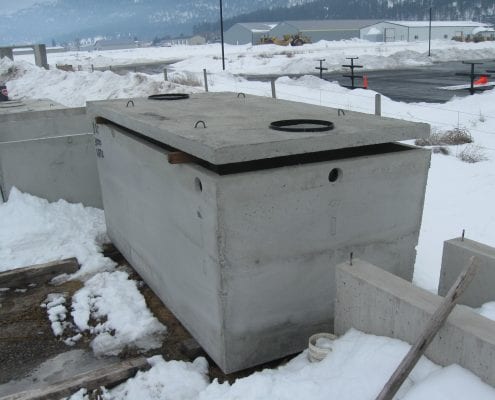
A septic system is three things working as one: a tank that settles solids, a drainfield that returns clarified water to the soil, and the soil itself doing the final treatment. Get the septic tank design right and each part carries its share. Get it wrong, usually by guessing at flow or ignoring the soil, and the drainfield pays for it first.
We build the tanks and design the layouts for systems across Northwest Montana, so this guide covers what actually drives a design: flow, soil, drainfield, and the local code that has final say.
Septic tank design is the process of sizing and configuring the tank and drainfield to a home’s wastewater flow and its site’s soil conditions, so solids settle in the tank and the effluent is absorbed safely by the ground. The rest is detail, and the detail matters.
Start with design flow, not tank size
Every design starts with a number: estimated daily wastewater flow. For a home, that number comes from bedroom count, because bedrooms are the accepted proxy for occupancy. More bedrooms means more assumed flow, which means a larger tank and a larger drainfield.
Design flow drives everything downstream. The tank is sized to hold that flow long enough for solids to settle. The drainfield is sized to absorb that same flow through your specific soil. Pick a tank size without pinning the flow first and you are guessing.
Once the flow is set, matching a tank to it is straightforward. Our guide to concrete septic tank sizes covers the gallon ratings and real dimensions by bedroom count.
The soil decides the drainfield
Here is where site-specific design begins. Two homes with identical flow can need very different drainfields, because the soil absorbs water at different rates. Sandy soil takes water quickly. Clay takes it slowly and needs far more field area for the same flow.
A percolation test, or perc test, measures how fast water drains through the soil at a site, and its result sets how much drainfield area the design requires. A soil evaluation goes further, examining soil texture, depth to bedrock, and depth to the seasonal water table. In Montana, that groundwater depth matters, because a high water table limits how a system can be built.
No responsible design skips the soil work. It is the difference between a drainfield that lasts and one that clogs.
Sizing and configuring the tank
With flow and soil in hand, the tank gets specified. Two-compartment tanks are common in modern design because the second chamber gives effluent a cleaner exit toward the field. An effluent filter on the outlet adds a last line of defense, catching solids before they reach the drainfield where they do the most damage.
The tank also has to be watertight. A concrete tank that passes its water test keeps groundwater out and effluent in, which protects both the system and the groundwater around it. That watertight integrity is a design requirement, not a bonus.
Gravity vs. pumped systems
Not every site lets gravity do the work. When the drainfield sits above the tank, or too far away for a gravity line to hold slope, the design calls for a pump.
A pumped design adds an effluent pump and control floats, usually in a separate pump tank, and often a pressure-distribution drainfield that doses the field evenly. This is where the pump calculations matter: the pump has to be sized to push the design flow through the laterals at the right pressure. We run those calculations and lay the system out as part of the design, so the pump, the floats, and the field are matched before anyone digs. Our septic tank installation guide covers how a pumped system is set and inspected.
Setbacks and site layout
A design is not just sizes; it is placement. Every component has required distances from wells, surface water, property lines, and buildings. The reserve area, a second drainfield location held for future use, is part of a complete design too.
Laying these out on paper before construction prevents the expensive surprise of a system that will not fit the site as drawn. It is far cheaper to move a line on a plan than a tank in the ground.
Montana permitting has the final say
Whatever the design says, the county approves it. In Montana, septic systems are permitted at the county level through the local health department or sanitarian, under Montana DEQ standards. The approved design defines the tank size, the drainfield, the setbacks, and the system type, and the permit enforces all of it.
That is why the design comes before the shopping. A tank ordered ahead of an approved design is a gamble on a number the county has not signed off on yet.
Septic tank design for difficult sites
Not every lot is a flat field with deep, sandy soil. Montana has plenty of sites that complicate a septic tank design: a high seasonal water table, shallow bedrock, heavy clay, steep slopes, or a lot too small to fit a conventional drainfield and its reserve area.
Difficult sites call for alternative designs. A mound system builds the drainfield up in imported sand where native soil or groundwater will not allow a standard trench. An advanced treatment unit cleans the effluent further before it reaches the field, which can shrink the field area a poor site needs. A pressure-distribution field doses effluent evenly across a constrained area.
These designs cost more and almost always need professional engineering, but they make a buildable system out of a lot a conventional design would fail on. If your site has any of these red flags, factor the harder design into your budget and timeline early, not after a failed perc test.
Common septic tank design mistakes
Most system failures trace back to a design shortcut, not a product defect. The usual ones: guessing at flow instead of sizing to bedrooms, skipping or rushing the soil work, undersizing the drainfield to save money, and ignoring the reserve area so there is nowhere to go when the first field ages out.
The other common miss is ordering a tank before the design is approved. A good septic tank design is finished and permitted before anything is bought or dug. Every one of these mistakes is cheap to avoid on paper and expensive to fix in the ground.
How long does a well-designed system last?
A septic system that is designed and built right lasts for decades. The concrete tank itself outlasts the rest of the system by a wide margin. The drainfield is usually the limiting part, and its life depends almost entirely on the design: a field sized correctly for the soil, fed clarified effluent through a good tank and filter, and never overloaded, can run for decades before it needs attention.
The reverse is also true. An undersized field, or one fed solids from a neglected tank, can fail in a handful of years. The biggest lever on how long a system lasts is not the products in it; it is the design behind them.
Frequently asked questions
How is a septic system designed?
A septic system is designed by estimating the home’s daily wastewater flow, usually from bedroom count, then sizing the tank to settle that flow and sizing the drainfield to absorb it through the site’s specific soil. A soil and percolation test sets the drainfield area. The design also fixes setbacks, the system type, gravity or pumped, and a reserve area, and it must be approved by the county before construction.
How do you size a septic tank?
A septic tank is sized to the home’s design flow, which is based on the number of bedrooms. As a general rule a 1000-gallon tank suits up to about three bedrooms and a 1500-gallon tank suits four to five, but the required minimum is set by your county and Montana DEQ. The tank must hold the flow long enough for solids to settle before effluent moves to the drainfield.
What is a perc test for a septic system?
A percolation test measures how quickly water drains through the soil at a proposed drainfield site. The rate determines how much drainfield area the design needs: fast-draining sandy soil needs less area, slow-draining clay needs more. A perc test is usually paired with a soil evaluation that checks soil texture, depth to bedrock, and depth to the seasonal water table.
Do you need an engineer to design a septic system?
Simple residential systems are often designed by a licensed installer or a sanitarian, while complex sites, high flows, or commercial and communal systems typically require an engineered design. Steep slopes, poor soil, a high water table, or a pumped system usually push a design toward professional engineering. Your county sets the threshold for when a stamped design is required.
What is the difference between a gravity and a pumped septic system?
A gravity septic system relies on slope to carry effluent from the tank to the drainfield. A pumped system uses an effluent pump and control floats to move effluent under pressure, which is needed when the drainfield is uphill or too far for gravity. Pumped systems often use pressure distribution to dose the drainfield evenly and require pump sizing as part of the design.
What makes a good septic tank design?
A good septic tank design sizes the tank and drainfield to the home’s real flow and the site’s actual soil, holds a reserve drainfield area, respects every setback, and is approved by the county before construction. It matches the system type, gravity or pumped, to the site rather than forcing a standard layout onto a difficult lot. The test of a good design is a system you never have to think about.
Design it on paper, build it once
The best septic tank design is the one that never asks for attention. That comes from three unglamorous decisions made in the right order: pin the flow, test the soil, then size the tank and field to both. Everything else, from tank compartments to pump floats, follows from those three. Skip them and the system tells you, usually through a failing drainfield a few years in.
Get your system designed by the people who build the tanks
Our in-house engineering team designs and lays out systems every week, and we build the tanks that go in them. When you bring us a site, we help pin the design flow, coordinate the soil work, size the tank and drainfield together, and on a pumped system we run the pump calculations so the whole system is matched from day one.
There is one number on a septic design that quietly determines whether your drainfield lasts fifteen years or a lifetime, and most homeowners never see it.
Talk to us about your system design, start with the complete guide to concrete septic tanks, or see product options on the concrete septic systems page.