
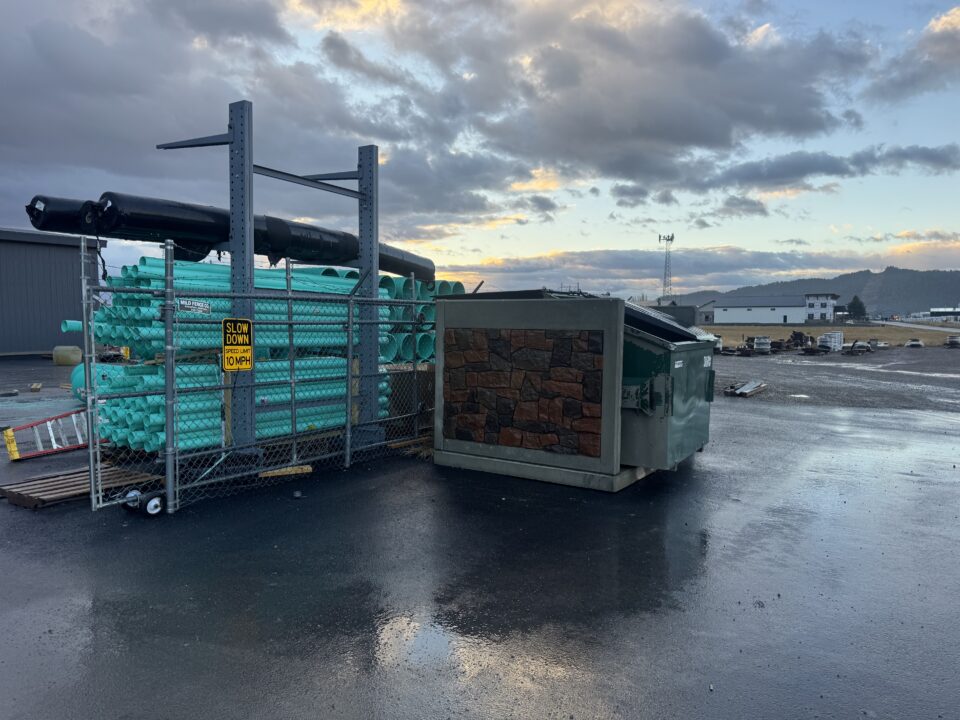
A dumpster enclosure is a three-sided wall around a commercial trash or recycling container, closed on the fourth side with gates. It hides the dumpster from the street, keeps trash from blowing around, and gives the hauler a clean pad to work from. Many cities require one on commercial, multifamily, and institutional site plans. We build them from precast concrete panels cast in Kalispell, Montana, and set them in a day.
Typical dumpster enclosure dimensions
Every city and hauler has its own standard, so treat these as planning numbers and confirm against yours. Here is what four published city standards call for:
| Item | Typical requirement | Example source |
|---|---|---|
| Interior, single 2 to 3 yd container | 10 ft wide x 7 ft deep | Grand Junction, CO |
| Interior, single 4 to 8 yd container | 12 ft wide x 10 ft deep | Grand Junction, CO |
| Interior depth | 10 ft minimum, 11 ft if bollards or a curb sit behind the container | Logan, UT |
| Gate opening, single | 12 ft clear minimum | Logan, UT; Greensboro, NC |
| Gate opening, double | 22 to 24 ft clear minimum | Greensboro, NC; Logan, UT |
| Wall height | 6 ft | Logan, UT; Wheat Ridge, CO |
| Gate swing | Open at least 100 degrees and stay open during service | Grand Junction, CO; Greensboro, NC |
| Container pad | 4 in. reinforced concrete minimum | Grand Junction, CO (recommended) |
| Truck apron | 6 ft of 8 in. reinforced concrete in front of the enclosure | Grand Junction, CO (recommended) |
| Bollards | Two fixed posts behind each container | Greensboro, NC |
| Location | Not within 5 ft of windows, doors, or combustible walls | Wheat Ridge, CO |
The double enclosure is not just two singles side by side. Most standards size it by doubling the width or adding about 10 ft of opening per extra container, so a trash plus recycling layout runs about 22 to 24 ft wide.
Before you design: call your hauler. The truck type (front-load or rear-load), the container sizes they will drop, and the approach they need decide the layout more than the walls do. Then check your city’s zoning or public works standard for height, materials, and gate rules.
Why precast concrete instead of block
Most enclosures are built from CMU block, and most of them look beat up within a few years. The hauler drops the container back into place every pickup, and anything that rolls or swings hits the wall.
| Precast concrete enclosure | CMU block enclosure | |
|---|---|---|
| Site time | Set in a day on a ready footing | Masons for days to weeks, plus grout and cure |
| Impact damage | Solid reinforced panel, no mortar joints to knock loose | Units chip and crack; joints open up |
| Winter | Cast indoors, set in any weather a crane can work in | Masonry needs cold-weather protection below 40°F |
| Engineering | Panels and connections engineered before casting | Many cities require engineering for masonry enclosures (Wheat Ridge, CO is one) |
| Fire | Noncombustible | Noncombustible |
| Look | Smooth, sandblast, or form-liner finish to match the building | Split-face or painted block |
The schedule is where precast wins on a commercial job. The enclosure is often one of the last things on the site plan, and nobody wants masons on site the week the building is supposed to open.
How we build a precast dumpster enclosure
- Layout. You send the site plan, the container sizes, and your hauler’s requirements. We lay out the panels, the gate opening, and the embeds.
- Foundation. The project engineering sets the footing. We can cast the footing in our plant, or your contractor pours it on site and we set our panels on top of it.
- Casting. Panels are cast indoors in our NPCA-certified plant, with steel embeds for gate posts and hinges cast in. We fabricate our own embeds in house, so the gate hardware lines up with the panel, and we can fabricate the steel gates too.
- Delivery and set. We deliver on our own trucks and set a typical enclosure with our crane truck in a single day.
- Finish. Smooth gray, sandblast, or a form-liner texture such as barnwood or stone, with stain or paint if the building calls for it. See architectural precast concrete panels for finish options.
Gates, bollards, and the details that fail first
- Gates take more abuse than the walls. Specify heavy hinges, drop pins or cane bolts that hold the gates open during service, and a gate post tied into the concrete, not bolted to its face.
- Bollards or a curb behind the container keep it from being shoved into the back wall. If you add them, add about a foot of depth (Logan’s standard goes from 10 ft to 11 ft).
- The apron in front of the enclosure carries the truck’s front wheels every pickup. A thin slab there cracks first. Grand Junction recommends 8 in. reinforced concrete for the first 6 ft.
- Drainage. Slope the pad so water does not pond inside the enclosure and freeze around the container wheels.
- Pedestrian door. If staff carry trash bags in, a man-door on the side saves them from opening the big gates. It can also be part of an accessible route to the container.
What a precast dumpster enclosure costs
Price depends on the size (single or double), wall height, finish, gates, and whether we supply the footing. A plain gray single enclosure is the low end; a double with form-liner finish, gates, and a precast footing is the high end. On cost, precast usually lands close to block, and it wins on schedule and on what the enclosure looks like five years later. Send us your site plan and we will price it.
Frequently asked questions
What size should a dumpster enclosure be?
For one front-load container, plan on roughly 10 to 12 ft wide and 7 to 10 ft deep inside, with a 12 ft clear gate opening and 6 ft walls. A double enclosure for trash and recycling runs about 22 to 24 ft wide. Your city and your hauler set the final numbers, so confirm with both before you design.
Do I need a permit or city approval for a dumpster enclosure?
Usually, on commercial and multifamily sites. Many cities review the enclosure as part of the site plan and set rules for height, materials, gates, and location. Check with your city’s planning or zoning office.
Is a concrete dumpster enclosure better than a block one?
Precast concrete is solid reinforced panels with no mortar joints, so it holds up better to container and truck impacts, and it sets in a day instead of taking masons a week or more. Both are noncombustible. Precast can also carry a textured finish to match the building.
How long does it take to install a precast dumpster enclosure?
Once the footing is ready, a typical single or double enclosure is set in one day with our crane truck.
What is a dumpster corral?
Dumpster corral is another name for a dumpster enclosure: a walled area with gates that holds commercial trash and recycling containers. Some cities and haulers also call it a trash enclosure or refuse enclosure.
Build it once
A dumpster enclosure gets hit every week for as long as the building stands. Build it out of something that can take it. Send us your site plan, your container sizes, and your hauler’s requirements, and we will come back with a layout and a price. Get an estimate, or see our other site and screen walls.